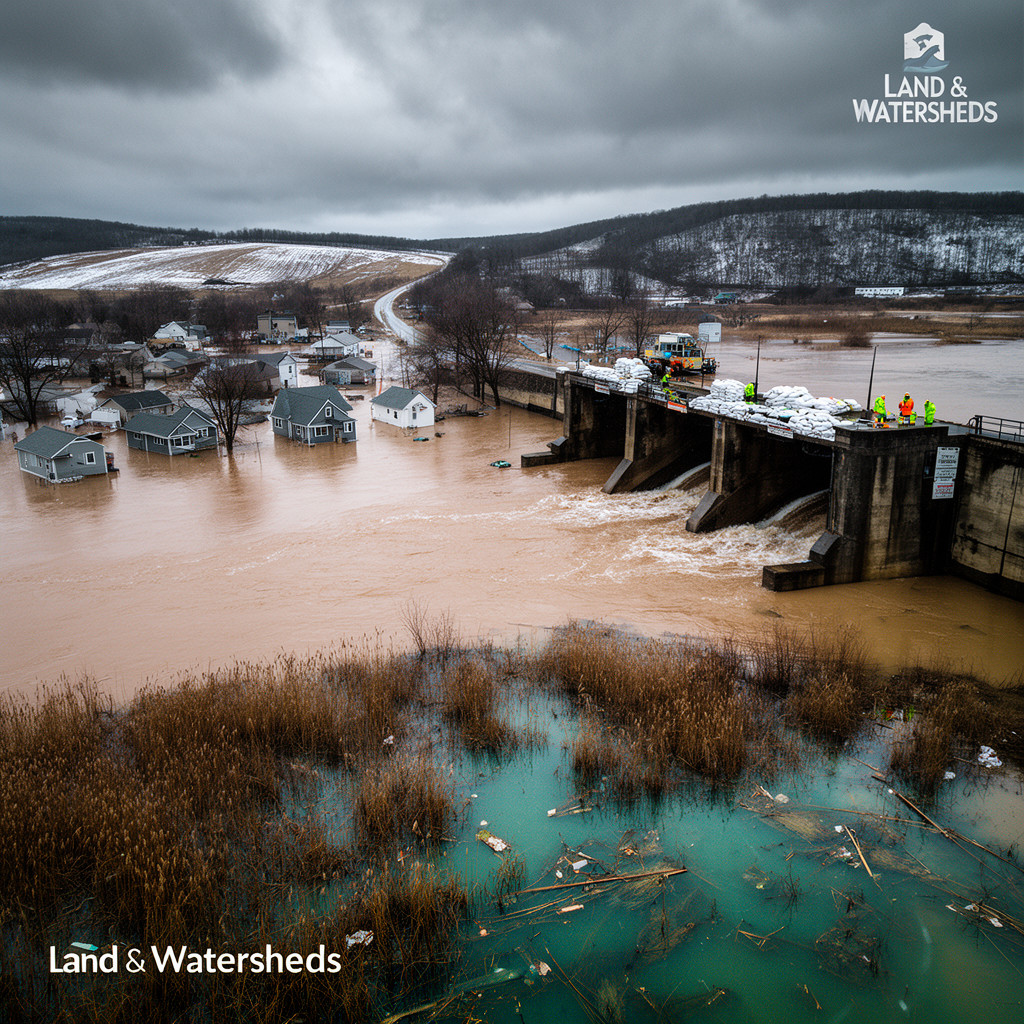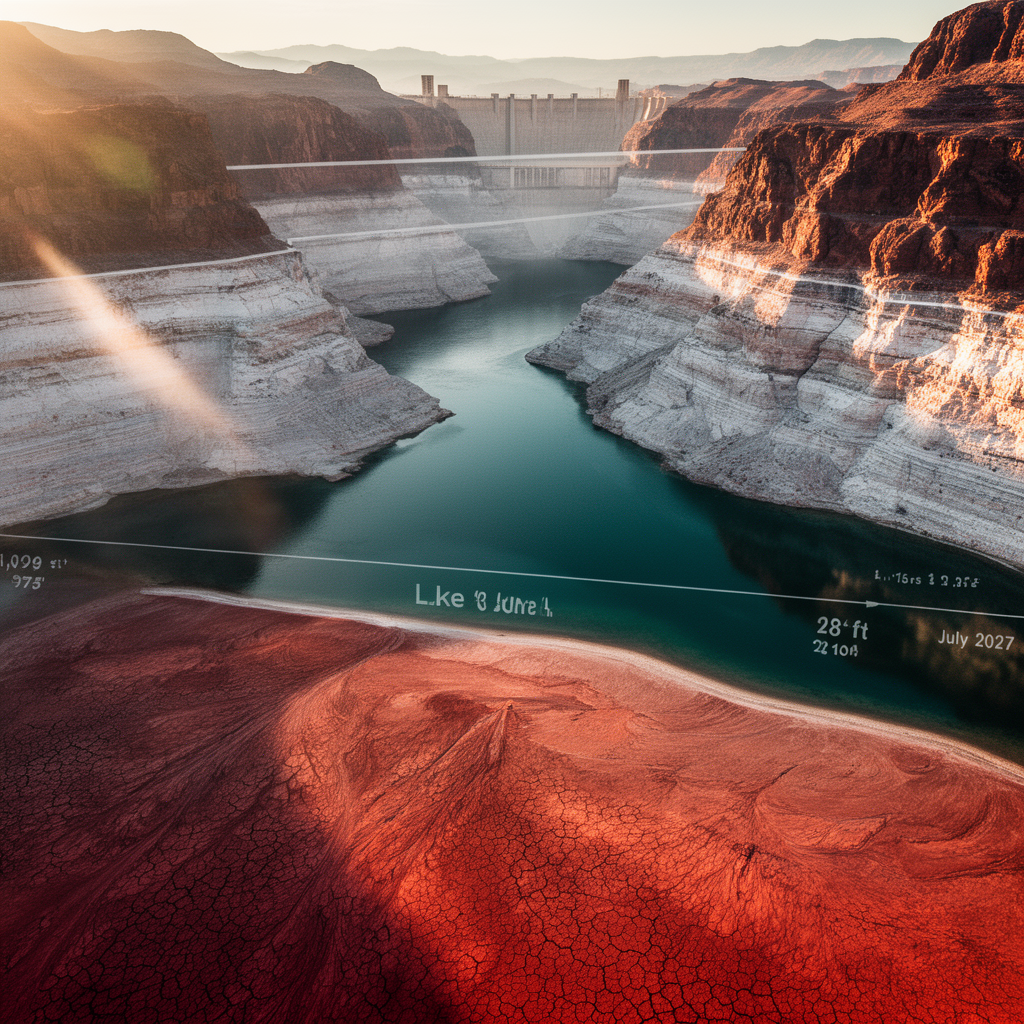
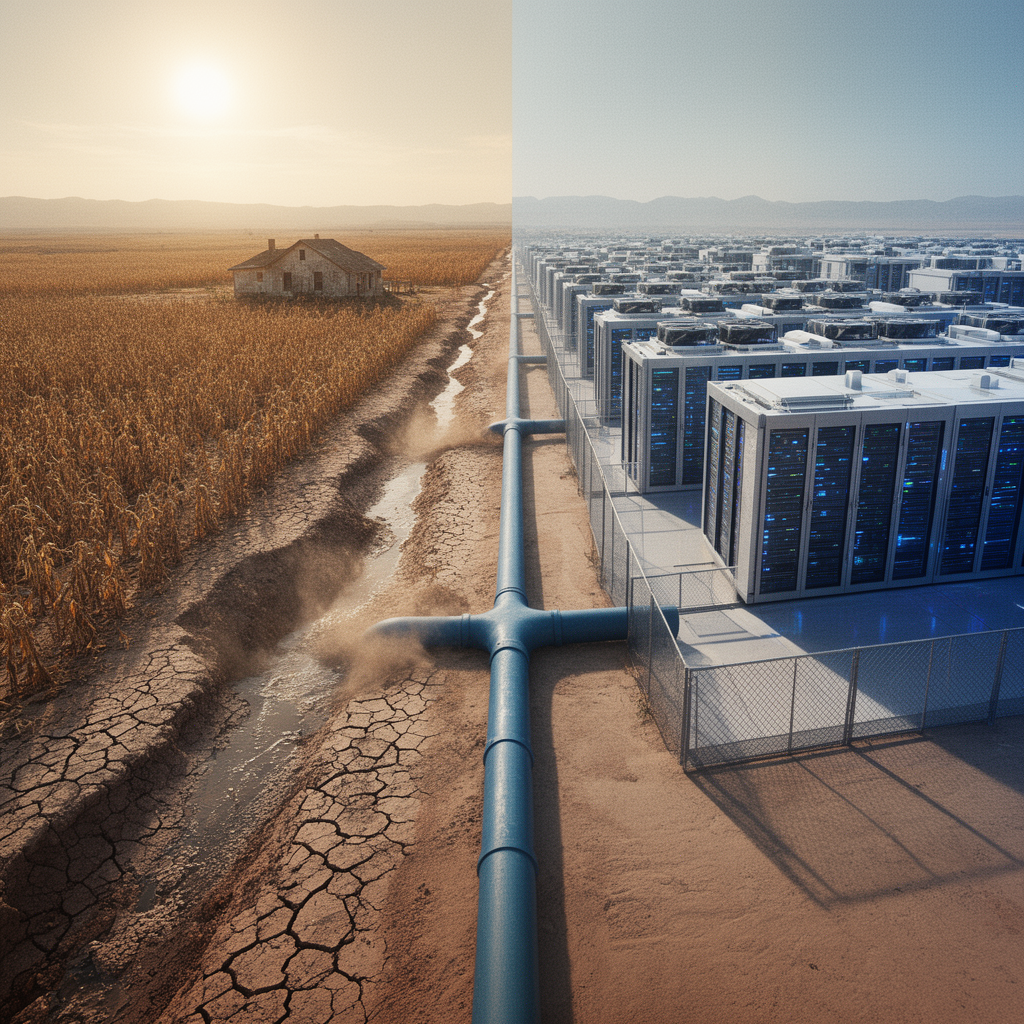
There is a comfortable myth that artificial intelligence lives in the cloud, weightless and clean. It does not. Every prompt you type lands on a physical chip that runs hot, and somewhere a very real water supply is being spent to carry that heat away. For those of us who manage watersheds for a living, that fact moves AI out of the technology section and into our own backyard.
The numbers arrived with force this month. In a report published on June 3, 2026, the United Nations University Institute for Water, Environment and Health estimated that the world's data centers consumed about 4.5 trillion liters of water in 2025, and projected that figure to roughly double to 9.3 trillion liters a year by 2030. As the institute's director and lead author Kaveh Madani put it, the public still treats AI as software, when it is in fact physical infrastructure: data centers, power generation, cooling systems, chips, land, and water. That reframing is the whole point. The intelligence may be artificial. The water it drinks is not.
A data center consumes water in two distinct ways, and both matter for anyone doing a basin water budget.
The first is direct evaporative cooling. Many facilities pull local freshwater through cooling towers, run it past the hot servers, and let it evaporate to shed the heat. That water leaves the local watershed for good. It is a consumptive use in the truest sense, the same category as irrigation, not a withdrawal that returns downstream.
The second is indirect, through the power itself. The electricity feeding those servers often comes from thermal plants (gas, coal, nuclear) that lean on steam turbines and their own cooling water. So the digital draws water twice: once at the rack, and once at the power plant. The UN University report found that data centers used 448 terawatt-hours of electricity in 2025, more than the entire country of Saudi Arabia, and that 80 to 90 percent of AI's energy use now comes not from training models but from inference, the everyday running of them to answer prompts.
I take this one personally. I run a custom water-cooled loop on my own workstation, so I have watched, at my own desk, exactly how much heat computation throws off and how hard it is to move. Scale that intuition from one machine to a building full of them, then to a region full of buildings, and you arrive at a water resources problem wearing a technology costume.
You have probably seen the headline: one AI conversation costs a bottle of water. The honest version is more interesting, and more useful to an engineer.
That widely cited figure traces to 2023 work by Pengfei Li and colleagues, which estimated roughly 500 milliliters of water for every 20 to 50 queries to a large language model. Separate UC Riverside research, reported by The Washington Post, put a single 100-word response near 519 milliliters. Meanwhile OpenAI's own leadership has claimed an average query uses about 0.3 milliliters, and Google has reported a median Gemini text prompt at about 0.26 milliliters. That is a spread of three orders of magnitude.
The gap is not a lie on anyone's part. It is a measurement choice. The small numbers count only operational cooling water at the server. The large numbers include the water embedded in electricity generation and the full supply chain. This is exactly the kind of boundary problem we face constantly in water accounting: define the system boundary differently and the answer changes by a hundredfold. The per-prompt number was never the story. The aggregate is. ChatGPT alone is estimated to handle around 2.5 billion prompts per day, and at that volume even a conservative estimate becomes a withdrawal worth modeling.
The strain is not spread evenly, and that is what should concern water resources professionals most. Data centers are frequently built where land is cheap and incentives are generous, and those places are often already water-stressed. Roughly one in five data centers in the United States draws from watersheds under moderate to high drought stress. A large hyperscale facility can consume up to 5 million gallons of water per day, which is the domestic draw of a town of 50,000 people, landing on a basin that may already be fully allocated.
The results are showing up as genuine resource conflicts. A Google project in Chile was blocked by courts after community opposition. In Querétaro, Mexico, fast-tracked data centers have raised alarms over water supply during prolonged drought. In Ireland, data centers grew to consume 21 percent of the country's metered electricity, prompting a pause on new approvals around Dublin. North American data centers alone consumed on the order of one trillion liters of water in 2025, and more than a dozen investors are now pressing the largest operators for site-level water disclosure rather than vague corporate totals.
This is the part of our field that is less hydrology and more allocation. When a basin is already spoken for, a large new user does not add demand in a vacuum. It displaces an existing one, often agriculture or a community well. The question of who gets displaced is a water resources decision dressed up as an economic development announcement.
Under mounting pressure, the major operators have responded. Amazon, Google, Microsoft, and Meta have all pledged to become "water positive" by 2030, meaning they aim to return more water to communities and ecosystems than they consume. There is real progress and real engineering behind some of it. Amazon disclosed withdrawing about 2.5 billion gallons across its global data centers in 2025 and reported reaching 75 percent of its water positive goal that year, up from 53 percent the year before. Google has committed 500 million dollars to public water infrastructure. The genuine technical wins include closed-loop and air cooling that stop evaporating water (at the cost of more electricity for fans), and switching operations to recycled or non-potable water instead of drinking supplies.
But the offset accounting deserves scrutiny, and this is where our profession has something specific to say. Water offsetting does not work the way carbon offsetting does. A ton of carbon removed anywhere cancels a ton emitted anywhere, because the atmosphere mixes globally. Water does not. It is intensely local. Restoring a wetland in one watershed does not refill the aquifer you drained in another. A former Amazon water sustainability manager publicly called the offset principle unethical for exactly this reason. "Water positive" only means something if the accounting is done basin by basin. A company can be water positive on a global spreadsheet and water negative in the precise basin it is draining, and the basin is the only scale the people living there experience.
For our field, the rise of AI infrastructure is not someone else's department. A large data center is a new consumptive demand on a basin, and it should be evaluated with the same rigor we would apply to any other major withdrawal. That means insisting on site-level water budgets, not corporate averages. It means treating the indirect, power-related water draw as part of the footprint, not a footnote. And it means holding "replenishment" claims to a watershed-specific standard, the same way we would never accept a mitigation credit in the wrong drainage.
For island and Caribbean contexts the stakes sharpen further. Treated water is expensive and energy is fragile, so any large new cooling load competes directly with community supply and resilience. If this infrastructure expands into water-stressed places, the right question for our profession is not whether AI is useful. It plainly is, including for the climate and water work we do. The question is whether the basins being asked to cool it can actually afford the withdrawal, and whether anyone is being asked to model that before the permit is signed.
The cloud has a water table. It is time we treated it like one.