Scour is the leading cause of bridge failure in the United States and destroys culvert outlets, yet outlet protection is routinely value-engineered away to save costs. Structures can operate for decades without visible damage, then fail suddenly when a single storm develops the right hydraulic conditions for deep scour.
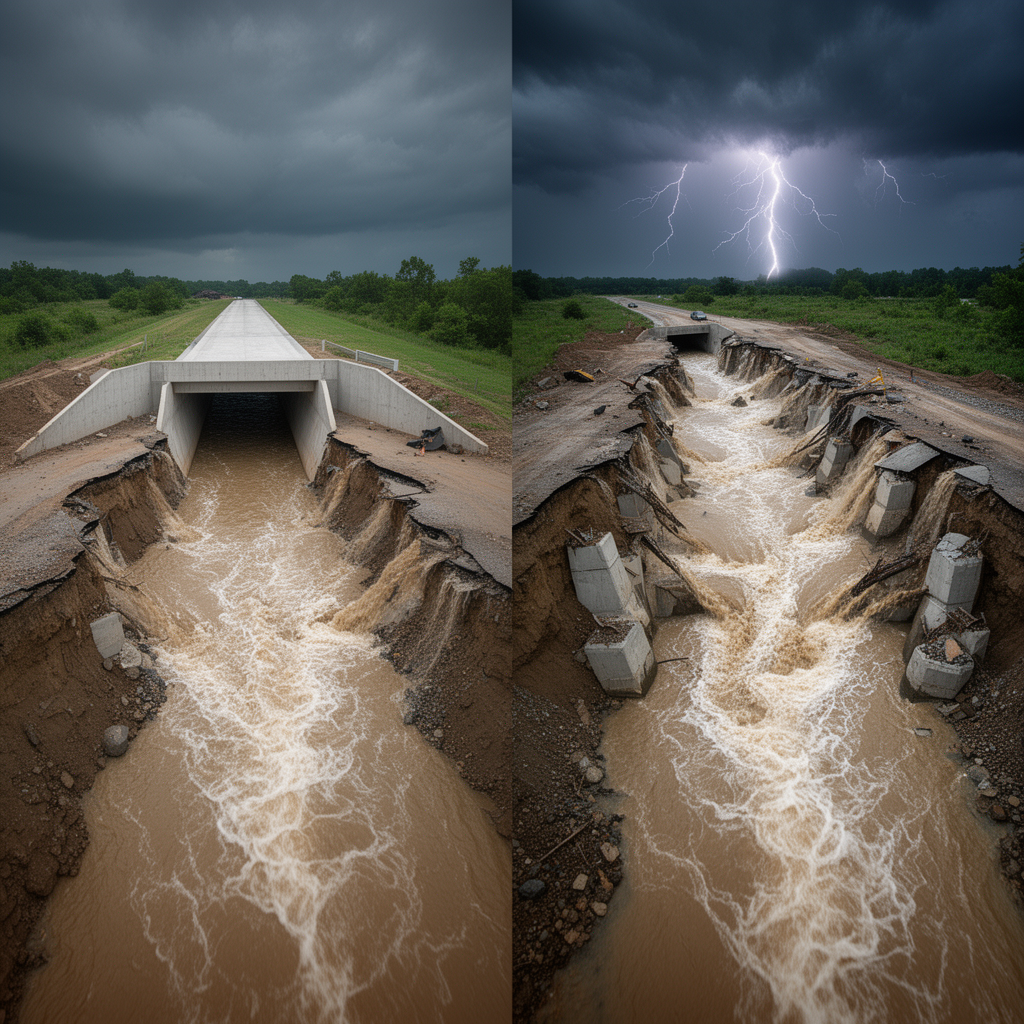
A culvert fails. The road above it drops. The embankment erodes. The approach fill washes downstream in a brown slurry that was, until about six hours ago, a functional piece of infrastructure.
The structural engineer looks at the concrete and says it's fine. The hydraulic engineer looks at the inlet and says it passed the design storm. Everyone is technically correct. Nobody is explaining the actual failure mechanism, which is scour: the progressive erosion of streambed and bank material at and downstream of the outlet that removed the foundation from under a structure that, on paper, had every reason to be standing.
Scour is one of the most consequential and consistently underweighted forces in drainage engineering. It is the leading cause of bridge failure in the United States. It destroys culvert outlets, undermines channel linings, destabilizes retaining walls, and converts carefully designed outfall structures into expensive debris piles. And it does all of this in a way that is often invisible until the moment of failure, because the damage accumulates below the waterline, in places that are difficult to inspect and easy to defer.
Scour is the hydraulic erosion of bed and bank material caused by flowing water. It is not a design defect in itself, it is a physical process that occurs whenever flowing water exerts tractive forces on erodible material that exceed the material's resistance to erosion. Every natural stream scours and deposits continuously as discharge fluctuates. The problem for engineered drainage systems is that structures concentrate flow, increase velocity, and create turbulence patterns that can generate scour rates far exceeding what the natural channel experiences under the same discharge.
There are several distinct scour mechanisms relevant to drainage design. General scour refers to the lowering of the overall streambed elevation during flood events, as increased discharge and velocity mobilize more sediment than the stream is depositing. Contraction scour occurs when flow is constricted through a narrower section, a culvert barrel, a bridge opening, a channel narrowing, which accelerates the flow and increases its bed shear stress. Local scour develops around individual structures, pier footings, abutments, culvert outlets, apron edges, where turbulence and flow separation create intense, localized erosion. In practice, all three mechanisms can occur simultaneously and interact in ways that amplify the total scour depth beyond what any single mechanism would predict in isolation.
For culvert outlets, which is where the issue most commonly manifests in smaller drainage infrastructure, the critical mechanism is typically the combination of contraction scour through the culvert barrel and local scour at the outlet. Water exits the culvert at elevated velocity, impacts the tailwater pool or streambed directly, and creates a scour hole whose depth and extent depend on the outlet velocity, the tailwater conditions, the erodibility of the bed material, and the presence and adequacy of energy dissipation measures.
Scour's most dangerous characteristic from an infrastructure management perspective is its episodic nature. A drainage structure can operate for years or decades without visible scour damage, because the storms it has experienced have not been large enough or long enough to develop significant scour depth. Then a single event, often not the largest storm on record, simply a storm large enough to exceed a critical velocity threshold or sustain erosive conditions long enough to develop a scour hole, produces rapid, deep scour that undermines a foundation that has never been stressed before.
The structure doesn't look vulnerable before the event. There may be no visible distress. The scour potential has been accumulating in the streambed geometry and the unprotected foundation depth, invisible to visual inspection, waiting for the hydraulic conditions that will actualize it.
This failure mode is particularly acute for drainage structures that were designed and built before scour analysis was routinely required, which in the United States means a very large fraction of the existing infrastructure inventory. FHWA's HEC-18 scour design guidance was not widely adopted until the 1990s, following a series of catastrophic bridge failures that focused national attention on scour as a failure mechanism. Structures built before that period typically have no formal scour analysis, no documented scour-critical designation, and no routine scour inspection protocol.
In Puerto Rico, where steep watershed gradients produce high stream velocities and high sediment transport capacity, and where a substantial fraction of drainage infrastructure predates modern scour analysis standards, the combination of hydraulic conditions and infrastructure age creates a significant scour risk profile that is not always reflected in inspection programs or capital improvement priorities.
The most common scour protection measure for culvert outlets is riprap, an apron of angular rock placed downstream of the outlet to dissipate energy and protect the streambed from direct impingement of the outlet jet. When properly designed, correct stone size, correct apron dimensions, adequate thickness, keyed into the streambed to prevent undermining, riprap outlet protection is effective, durable, and relatively inexpensive relative to the structure it is protecting.
When improperly designed, undersized stone, inadequate apron length, insufficient thickness, no key trench, riprap provides the appearance of outlet protection without the hydraulic substance. It washes away during the design event, leaving the outlet exposed at precisely the moment when scour forces are highest.
When eliminated from the design entirely as a cost-saving measure, which happens, because outlet protection is a visible line item in a project budget and it is easy to argue that the concrete headwall is the structure and the riprap is optional, the culvert outlet is essentially unprotected against scour from any event that exceeds the baseline conditions the natural streambed can tolerate.
The calculus of this decision is straightforward and consistently misapplied. The cost of a properly designed riprap outlet protection apron for a typical culvert is a fraction of the total project cost. The cost of replacing a culvert that has been undermined by scour, including emergency response, road closure, embankment repair, and structure replacement, is typically an order of magnitude higher. This arithmetic is well understood. The value-engineering decisions happen anyway, because the scour failure is a future cost, probabilistic, borne by the operations budget rather than the capital budget, and invisible until it isn't.
HEC-18 provides the methodological framework for scour analysis at bridges and culverts. The calculations are not exotic. They require basic hydraulic data, design discharge, channel geometry, flow velocity, tailwater depth, and soil or rock erodibility characterization, and they produce estimates of general, contraction, and local scour depth that can be compared to foundation embedment depth to assess vulnerability.
For new structures, applying this framework during design is straightforward and should be standard practice for any hydraulic structure where scour failure would have significant consequences. For existing structures, systematic scour vulnerability assessment, particularly for structures with unknown foundation depths, structures in high-gradient streams, and structures known to carry significant design-event discharges, is essential infrastructure risk management.
Outlet protection design should be treated as a structural element, not an optional amenity. Stone sizing, apron dimensions, and embedment depth should be calculated, not estimated or copied from a standard detail without regard to the specific hydraulic conditions at the outlet. The standard detail is a starting point, not a substitute for site-specific design.
And budgets for outlet protection should be defended, not value-engineered away. The conversation about whether to include a properly designed riprap apron in a culvert project is a conversation about whether to accept a known, quantifiable structural risk to save a relatively small amount of money. Framed that way, the decision is usually clear, if the people making it understand what scour actually does to a culvert outlet when the protection isn't there.
The stream doesn't negotiate. It doesn't honor the budget. It scours to equilibrium, and it will find that equilibrium with or without the infrastructure in its way.
Q: What is scour?
A: Hydraulic erosion of bed and bank material caused by flowing water, concentrated and accelerated by structures like culverts and bridges.
Q: How do you prevent scour?
A: Properly designed riprap outlet protection with correct stone sizing, adequate apron dimensions, and embedment depth keyed into the streambed.
Q: When should you worry about scour?
A: At any hydraulic structure where scour failure would have significant consequences, especially structures with unknown foundation depths in high-gradient streams.
Q: Why do structures fail from scour?
A: Scour accumulates below the waterline invisibly, then undermines foundations suddenly during storms that exceed critical velocity thresholds.
Q: What is HEC-18?
A: FHWA scour design guidance providing methodological framework for calculating general, contraction, and local scour depth at bridges and culverts.