Most nature-based solutions are not innovations, they're partial recreations of natural systems we systematically eliminated. Bioswales replace riparian corridors we cleared. Constructed wetlands replace natural wetlands we drained. The framing matters because it determines whether we prioritize preservation or accept development followed by engineered restoration.
Somewhere in a municipal stormwater master plan near you, there is a section on nature-based solutions. It contains phrases like "green infrastructure," "ecological services," "resilience-based design," and possibly "biomimicry." It has attractive renderings of bioswales with native plantings and children playing near restored stream corridors. It may have received a sustainability award.
I am not being dismissive of any of this. Nature-based approaches to stormwater and flood management are often genuinely effective, sometimes superior to their engineered alternatives, and worth the serious professional attention they have been receiving over the past two decades.
I am, however, going to insist that we be clear-eyed about what we're actually doing when we implement them, because a significant portion of what the profession calls "innovative nature-based solutions" is, on close inspection, an engineered recreation of natural systems we removed. Which is valuable. But it is not the same thing as innovation, and it carries different implications for how we should approach preservation versus restoration decisions.
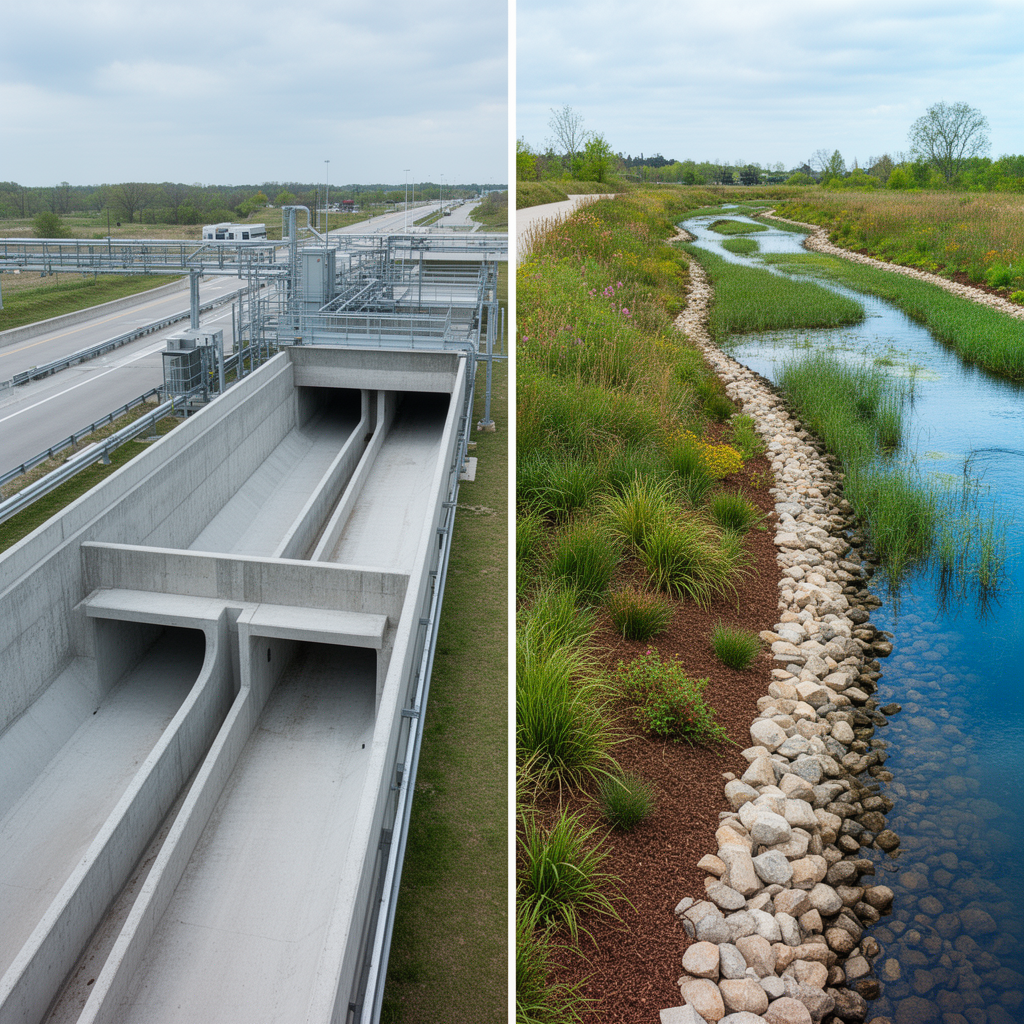
The term "nature-based solutions", NbS in the current shorthand, encompasses a broad range of practices that use or mimic natural processes to provide hydrological, ecological, or water quality benefits. Bioswales slow and infiltrate runoff using vegetation and engineered soil media. Constructed wetlands treat stormwater using natural biological and physical processes. Living shorelines stabilize coastal margins using vegetation and habitat structure rather than hard armor. Riparian buffer restoration reduces bank erosion, filters agricultural runoff, and provides temperature regulation and ecological connectivity. Floodplain reconnection restores hydraulic connection between streams and their adjacent floodplains to provide flood attenuation and habitat.
These practices are well-documented, generally effective within their design envelopes, and in many cases significantly cheaper to build and maintain than their conventional engineered counterparts. A constructed wetland that treats urban stormwater using biological uptake, sedimentation, and filtration costs a fraction of what a conventional treatment facility would cost to provide equivalent water quality improvement, and it provides habitat, aesthetic value, and carbon sequestration on the side. The value proposition is real.
Here is the thing that the nature-based solutions literature tends to gloss over: most of these practices are functional recreations of natural systems that we systematically eliminated during the 19th and 20th centuries.
The bioswale treats runoff that the original riparian corridor would have intercepted and infiltrated before we cleared it for development. The constructed wetland provides the nutrient processing that the natural wetland performed before we drained it for agriculture. The living shoreline stabilizes the coast that the natural marsh maintained before we filled it for a parking lot. The floodplain reconnection project restores the flood storage that the natural floodplain provided before we issued fill permits for it.
In each case, the "nature-based solution" is not adding a new capability to the watershed. It is partially restoring a capability that the watershed originally had and that human activity removed. The engineering is real. The ecological benefits are real. The cost-effectiveness relative to fully engineered alternatives is real. But the framing of these practices as innovations, rather than as partial remediation of damage we caused, creates a subtle but important distortion in how we think about land use decisions.
If bioswales are innovative solutions to urban stormwater management, then the implicit logic is that conventional development followed by bioswale installation is a reasonable and perhaps adequate approach to minimizing hydrological impact. If bioswales are partial replacements for natural systems we destroyed, then the logical priority is to avoid destroying the natural systems in the first place, and use bioswales only where that was not possible.
These are different policy positions. The framing determines which one we end up defaulting to.
To be direct: nature-based approaches genuinely outperform conventional engineered solutions in several specific contexts, and those contexts deserve to be clearly articulated rather than buried in general advocacy.
For distributed stormwater management in retrofit situations, where conventional detention or conveyance infrastructure cannot be added without prohibitive disruption to existing development, green infrastructure practices like bioswales, permeable pavement, and tree canopy management can provide meaningful runoff volume reduction at costs that are not achievable through pipe-based solutions. The value here is real and well-documented.
For water quality improvement in agricultural and mixed-land-use watersheds, constructed wetlands and riparian buffers consistently outperform conventional engineered treatment approaches in cost-effectiveness and long-term performance. The biological and physical treatment mechanisms in natural systems are genuinely superior to engineered analogs for many pollutant types and loading conditions.
For coastal resilience, natural shoreline features, mangroves, salt marshes, oyster reefs, seagrass beds, provide wave attenuation, storm surge reduction, and shoreline stabilization that hard armoring cannot replicate and that, once lost, is extraordinarily expensive to replace. The evidence base here is particularly strong, and the case for prioritizing preservation of intact natural shoreline features over any engineered alternative is compelling.
For ecological connectivity and habitat value, restored riparian corridors and floodplains provide services that no engineered infrastructure can provide at any cost. These are genuine irreplaceables.
The most important insight from taking nature-based solutions seriously, not as a trend but as a framework for understanding what natural systems actually do and why, is that it implies a clear hierarchy for land and water management decisions.
First, preserve what you have. Intact natural systems provide hydrological, ecological, and water quality services at zero cost, with zero maintenance, and at a level of complexity and effectiveness that engineered analogs can only approximate. Every wetland drained, every riparian buffer cleared, every floodplain filled is a loss of natural capital that will require expensive engineered replacement, partial, imperfect, and maintenance-dependent replacement, in perpetuity. The economics of preservation are almost always superior to the economics of destruction followed by restoration.
Second, restore where you can. Where natural systems have been damaged or removed and restoration is feasible, prioritize it over conventional engineered alternatives. The ecological co-benefits of restoration, habitat, water quality, carbon sequestration, educational and recreational value, make it systematically undervalued in conventional cost-benefit analyses that count only direct flood damage reduction.
Third, engineer where necessary. Where neither preservation nor restoration is feasible, in fully developed urban watersheds, at critical infrastructure crossings, in situations where the required hydraulic performance cannot be achieved through natural systems alone, conventional engineered solutions remain necessary and appropriate. They should be designed as efficiently as possible, with attention to the downstream consequences of their hydrological effects.
Nature-based solutions, properly understood, are not a replacement for this hierarchy. They are the practical implementation of its second tier, in situations where the first tier has already been foreclosed by previous decisions. They are valuable. They are also, in an important sense, evidence of failure, evidence that we didn't preserve the natural systems that would have made them unnecessary.
The most cost-effective nature-based solution is the one you never have to build because you protected the natural system it would have replaced.
Q: What are nature-based solutions?
A: Practices that use or mimic natural processes to provide hydrological benefits: bioswales, constructed wetlands, living shorelines, floodplain reconnection.
Q: When do nature-based solutions outperform conventional engineering?
A: For distributed retrofit stormwater management, agricultural water quality improvement, and coastal resilience where natural features provide irreplaceable services.
Q: What is the preservation hierarchy?
A: First preserve intact natural systems, second restore where feasible, third engineer where necessary, this minimizes long-term costs and maximizes ecological co-benefits.
Q: Are nature-based solutions always better?
A: No, they're best suited for specific contexts, fully developed urban watersheds and critical infrastructure often require conventional engineered solutions.
Q: Why does framing matter?
A: Calling restoration an innovation implies conventional development plus green infrastructure is adequate, calling it remediation prioritizes avoiding the damage in the first place.