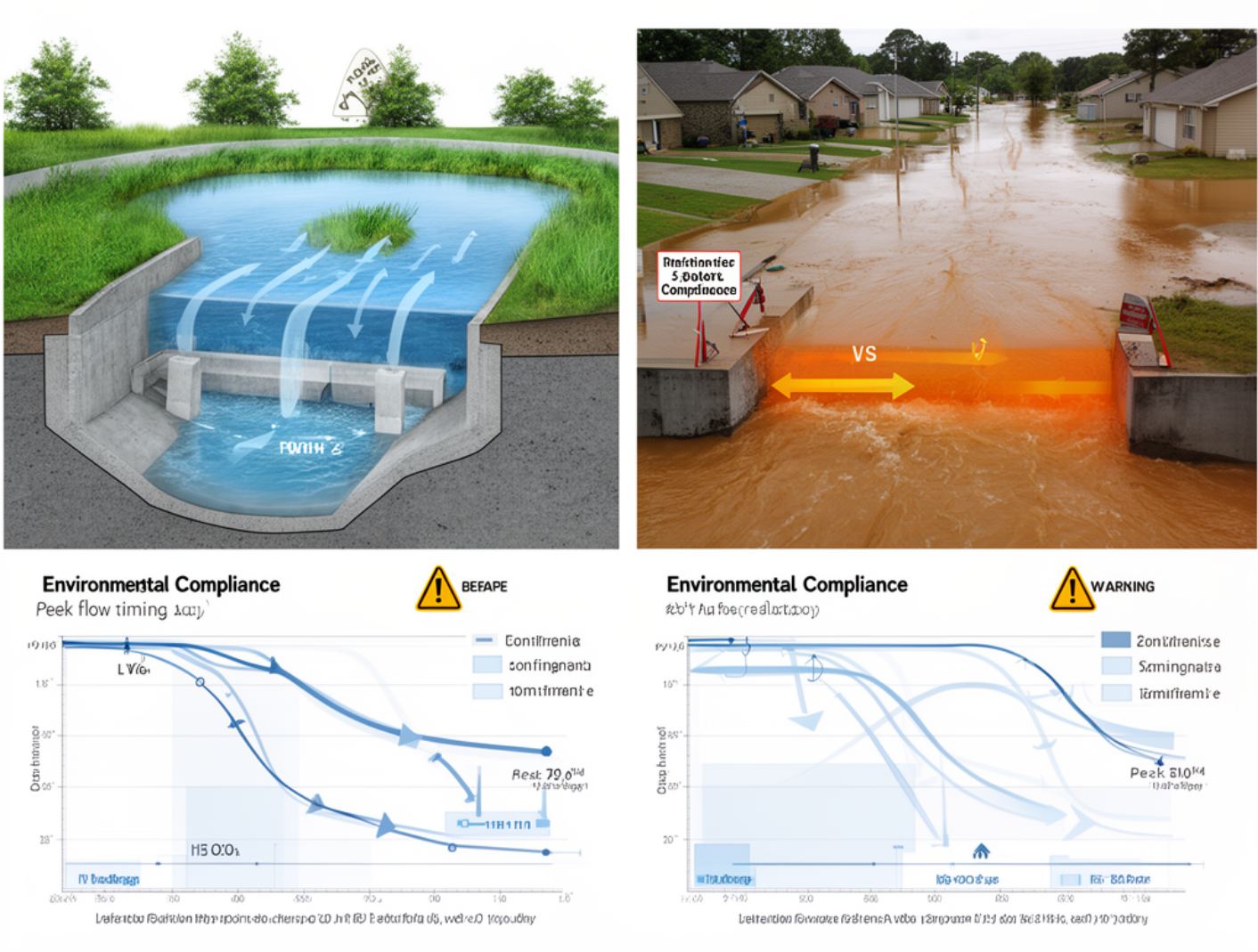
Detention basins reduce peak flow by releasing water slowly. But when that delayed outflow arrives downstream at the same time as other peaks instead of before or after, you've synchronized hydrographs that nature kept separate, potentially making downstream flooding worse despite full permit compliance.
Detention basins are one of the most popular tools in the stormwater management toolkit. They are visible. They are fundable. They photograph well for permit applications. They give everyone involved, the developer, the engineer, the reviewing agency, a satisfying sense that the flooding problem has been identified, addressed, and resolved.
Sometimes they work exactly as intended. Runoff enters, peak flow is attenuated, the hydrograph stretches out, downstream stages are reduced, everyone goes home happy.
And sometimes, in ways that are easy to miss if you're only looking at your project boundary and not at the larger watershed, a detention basin shifts the problem downstream rather than solving it. Not because it was designed poorly. Not because it failed. But because it worked precisely as designed, and the design didn't account for what happens when its delayed outflow meets the rest of the watershed at the wrong moment.
To understand why detention can sometimes make things worse, you need to understand what detention actually does to a hydrograph. A detention basin reduces the peak discharge from a site by storing a portion of the runoff volume and releasing it more slowly. The peak goes down. The duration goes up. The total volume, minus any infiltration or evaporation, remains roughly the same.
The critical variable that most project-scale analyses ignore is timing: specifically, when that attenuated outflow arrives at the downstream receiving channel relative to the natural peak of that channel.
In an undeveloped watershed, runoff from different sub-basins reaches the stream at different times depending on their respective travel times. The peaks are typically staggered, so the combined hydrograph at any given downstream point represents a superposition of multiple sub-basin peaks that don't all arrive simultaneously. This natural peak spreading is part of why undeveloped watersheds tend to have lower flood peaks than developed ones, even before accounting for infiltration differences.
When you install a detention basin on one sub-basin, you slow its outflow deliberately. But if that slowdown causes the sub-basin's peak to arrive at the confluence point later than it would have without detention, and specifically if it now arrives coincident with the peak from another sub-basin rather than before or after it, you have effectively combined two peaks that the natural system kept separated.
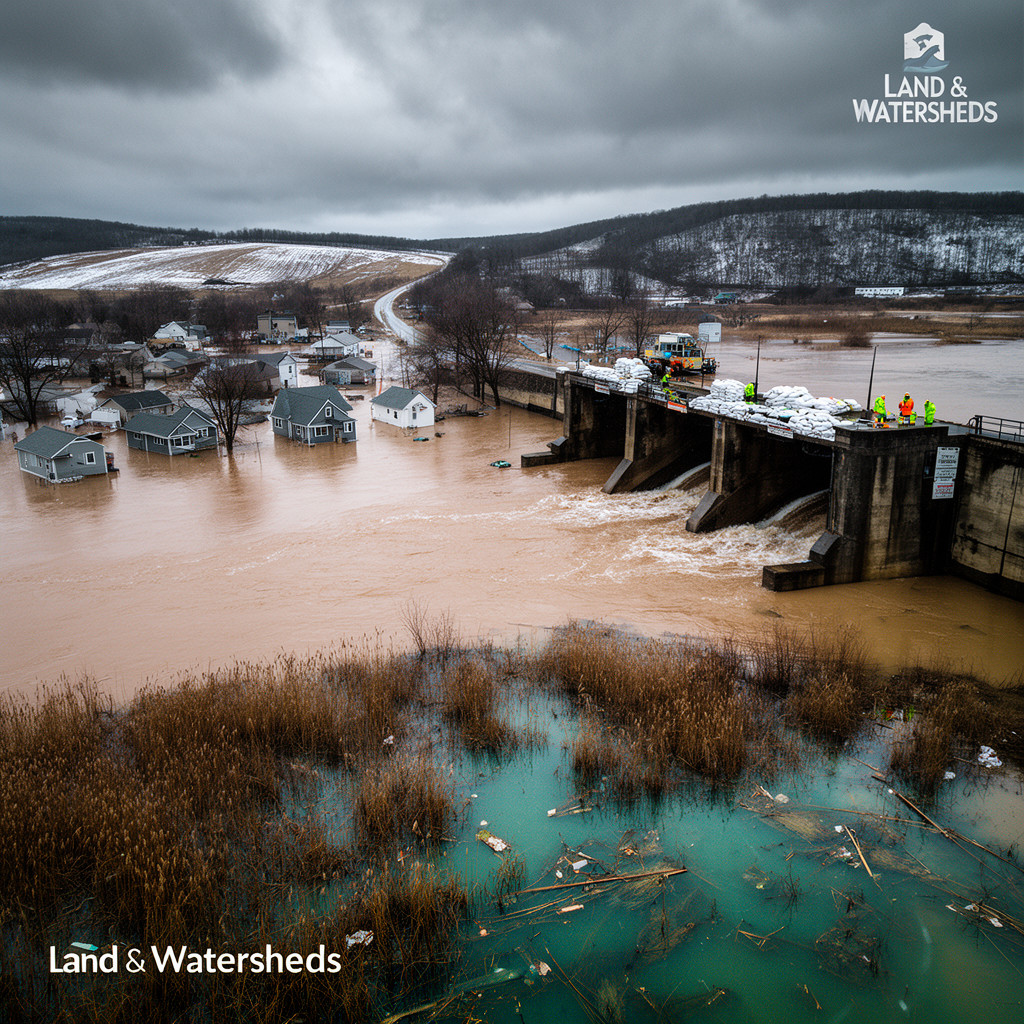
The result: higher downstream stage than would have occurred without the basin. Your pond is full, your permit is in order, and the neighborhood two miles downstream is getting water in their living rooms that they wouldn't have gotten before your project broke ground.
This is not an edge case. It is a documented phenomenon in watershed hydrology, and it becomes more common as watersheds become more developed and the cumulative effect of multiple detention basins begins to reshape the composite hydrograph in ways that no individual project-level analysis would capture.
The conditions that make it most likely: large watersheds with multiple developed sub-basins, each with its own detention facility, each independently permitted and each independently compliant. The individual basins all pass their design storm analysis. The cumulative effect of all of them simultaneously releasing attenuated outflow is never evaluated because no single permittee is responsible for the watershed-scale analysis.
Sub-basins with naturally fast response times that are being delayed to match the response time of slower sub-basins downstream. You've essentially synchronized hydrographs that nature kept asynchronous.
Receiving channels with limited conveyance capacity, where even moderate increases in peak stage translate quickly into overbank flooding.
In Puerto Rico, where steep watersheds have naturally fast response times and the receiving streams are often constrained by both natural channel geometry and aging urban infrastructure, the timing sensitivity of multi-basin stormwater systems is particularly acute. A detention basin that delays peak outflow by 30 minutes on a watershed with a time of concentration of 45 minutes is doing something very different hydraulically than the same basin on a slow-responding Midwest watershed with a 4-hour Tc.
Part of what makes this problem persistent is the structure of stormwater permitting itself. Most regulatory frameworks evaluate detention requirements at the project boundary. The standard condition is that post-development peak discharge at the site outlet shall not exceed pre-development peak discharge for the design storm. If your basin meets that standard, you get your permit.
This standard does not ask whether your attenuated outflow, combined with attenuated outflow from the five other permitted developments in the same sub-watershed, produces worse conditions downstream than would have existed without any of the development. It asks only whether your site, in isolation, is non-worse than the pre-development condition at your property line.
This is, to put it charitably, an incomplete framework. It is also the framework under which the vast majority of stormwater detention in the United States has been designed and permitted for the past several decades.
The problem is not that engineers are cutting corners. The problem is that the regulatory standard doesn't require the right analysis, and doing the right analysis, a full watershed-scale hydrologic model that evaluates cumulative timing effects across all sub-basins, is expensive, time-consuming, and well outside the scope of a typical site development permit.
The fix is not to stop building detention. Detention is genuinely useful, and in many contexts it is the best available tool for reducing flood peaks from developed land. The fix is to be more deliberate about what we're asking it to do and more honest about what it doesn't do.
Specifically: evaluate outflow timing relative to the receiving water. A site-level detention analysis that only checks the peak outflow rate is insufficient. The analysis should also characterize when the peak outflow arrives at the watershed confluence and whether that timing is beneficial or harmful relative to the natural sub-basin synchronization.
Design from the receiving water backward. Before sizing a detention basin to meet a permit standard, characterize what the downstream channel can actually tolerate, in terms of both peak stage and flow duration. Then work backward to determine what outflow characteristics from your site are actually compatible with that tolerance. This is a fundamentally different design question than "what size basin do I need to match the pre-development peak?"
Support watershed-scale planning. The cumulative timing problem is ultimately a watershed governance problem. It requires either a regulatory framework that evaluates cumulative impacts or a watershed management plan that coordinates individual project designs to produce an acceptable composite result. Neither of these is quick or cheap. Both are necessary.
Be honest with clients about what detention does and doesn't accomplish. A detention basin that meets the permit standard may or may not reduce actual flood risk for downstream properties. Those are different things. Decision-makers deserve to understand the difference.
Stormwater management that stops at the property line isn't really stormwater management. It is cost exporting with an engineer's stamp on it, technically compliant, locally effective, and potentially harmful at the scale that actually matters.
The detention pond is a tool. Like any tool, its usefulness depends entirely on whether you're using it to solve the right problem. If the right problem is "reduce flood risk in this watershed," then the analysis has to be conducted at the watershed scale, the design has to account for timing as well as magnitude, and the regulatory framework has to require evaluation of cumulative effects, not just site-level compliance.
Until that happens, detention basins will continue to be built, permitted, and celebrated as flood solutions while some of them quietly shift the problem downstream to people who never appeared on the permit application.
Q: How do detention ponds work?
A: Detention basins temporarily store runoff and release it slowly, reducing peak discharge but extending the duration of outflow.
Q: What is peak timing and why does it matter?
A: Peak timing refers to when flows from different sub-basins arrive at downstream confluences. If detention synchronizes previously staggered peaks, it can increase combined flood levels.
Q: When does detention backfire?
A: When the delayed outflow from a detention basin arrives at a downstream point coincident with peaks from other sub-basins, creating higher combined flows than would occur naturally.
Q: Why don't permits catch this problem?
A: Most permits evaluate detention at the property boundary without analyzing cumulative timing effects across multiple developments in the same watershed.
Q: What should designers evaluate?
A: Designers should analyze when the attenuated outflow arrives at watershed confluences and whether that timing is beneficial or harmful relative to natural sub-basin synchronization.